2025 Nobel Prize 파헤치기 3편 - Chemistry

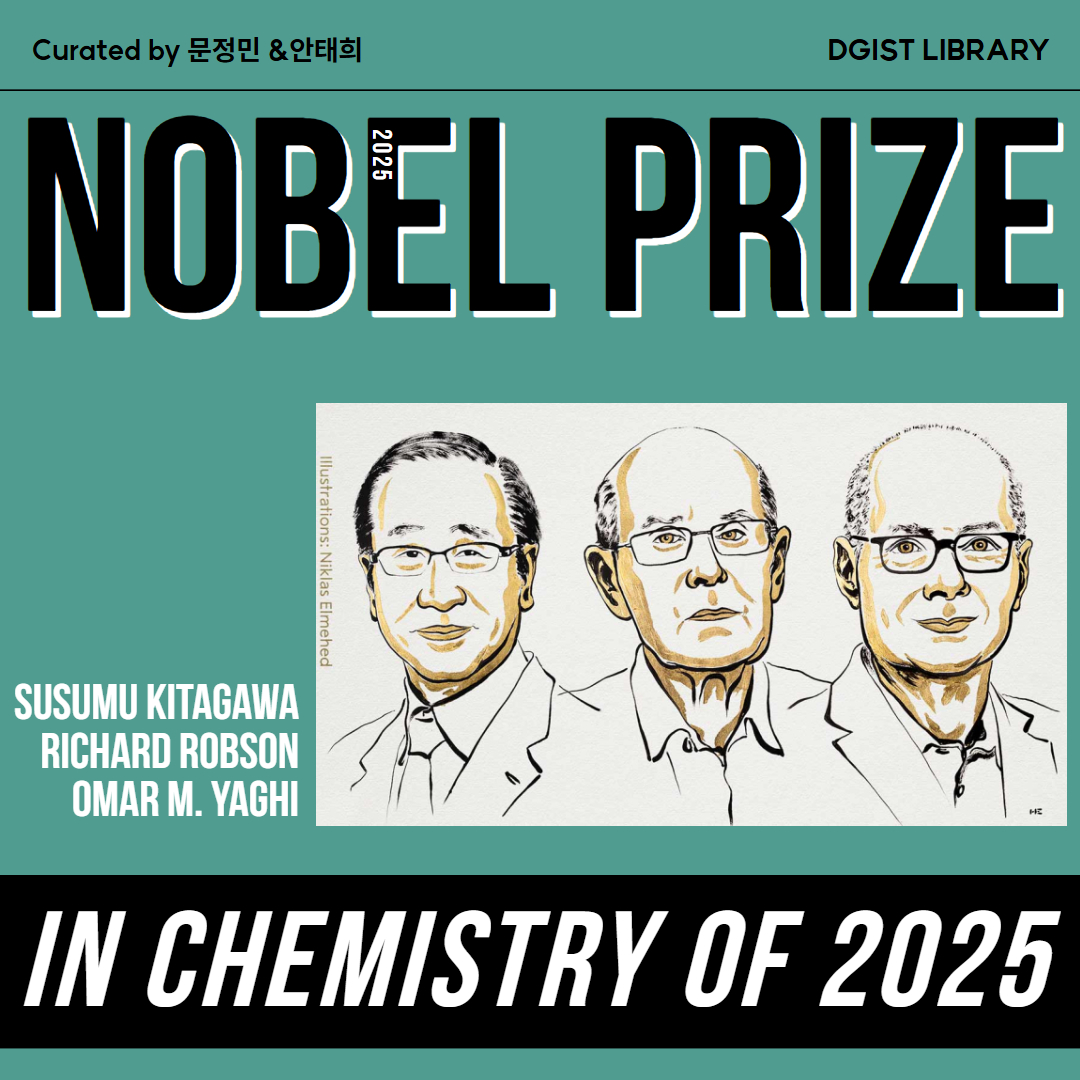
2025 노벨 화학상은 기타가와 스스무, 리처드 롭슨, 오마르 야기에게 수여되었습니다. 2025 노벨 화학상을 받은 연구 내용과 과학자들에 대해 함께 알아볼까요? [Curated by 일일 큐레이터 문정민, 안태희]
2025 노벨 화학상 - Nobel Prize in Chemistry 2025
The Nobel Prize in Chemistry 2025 was awarded jointly to Susumu Kitagawa, Richard Robson and Omar M. Yaghi "for the development of metal–organic frameworks"

Nobel Prize in Chemistry 2025. NobelPrize.org. Nobel Prize Outreach 2025. Mon. 8 Dec 2025. 
NobelPrize.org
Announcement of the 2025 Nobel Prize in Chemistry
The Nobel Prize in Chemistry 2025 was awarded jointly to Susumu Kitagawa, Richard Robson and Omar M. Yaghi "for the development of metal–organic frameworks" The Nobel Prize in Chemistry was announced at the Royal Swedish Academy of Sciences in Stockholm, Sweden. #NobelPrize © Nobel Prize Outreach Live stream terms of use: https://www.nobelprize.org/prizes/about/live-streams-terms-of-use/
바로가기
[노벨상 2025] 상용화 앞둔 '기후위기' 해결사 개발 과학자 3명 화학상(종합)
2025년 노벨 화학상을 수상한 기타가와 스스무 일본 교토대 명예교수, 리처드 롭슨 호주 멜버른대 교수, 오마르 야기 미국 버클리캘리포니아대(UC버클리) 교수(왼쪽부터). 위키미디어, 멜버른대 제공 올해 노벨 화학상은 새로...
바로가기
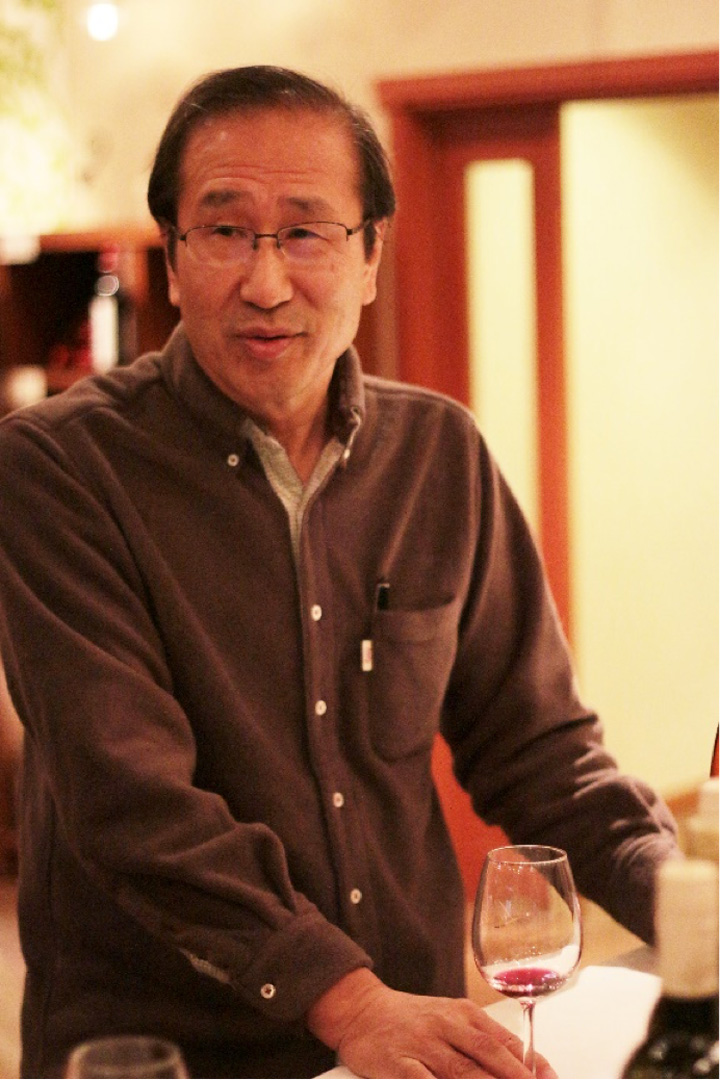
Laureates #1: Susumu Kitagawa
Susumu Kitagawa | Kyoto University iCeMS
institute for Integrated Cell-Material Sciences (iCeMS) strives to 1) create a new integrated discipline of cell-material sciences based on the cross-disciplinary field of chemistry, physics and cell biology and 2) become a global hub of career development for scientists.
바로가기
First reactions | Susumu Kitagawa, Nobel Prize in Chemistry 2025 | Telephone interview
“This is the mind of the researcher in Japan,” says Susumu Kitagawa, “Don’t switch off the light, even at night.” In this short conversation recorded the day after the announcement of his Nobel Prize in Chemistry, Kitagawa talks to the Nobel Prize’s Adam Smith about his approach to tackling grand challenges, and how to keep a lookout for the unexpected. He also explains how his perspective on research has a lineage that extends back to other Japanese Nobel Prize laureates Kenichi Fukui, Akira Yoshino and even Hideki Yukawa, the very first Nobel Prize laureate from Japan. © Nobel Prize Outreach. First reactions terms of use: https://www.nobelprize.org/ceremonies/streams-terms-of-use
바로가기
Article #1:
Kitagawa, S., Kitaura, R., & Noro, S. I. (2004). Functional porous coordination polymers. Angewandte Chemie International Edition, 43(18), 2334-2375.
The chemistry of the coordination polymers has in recent years advanced extensively, affording various architectures, which are constructed from a variety of molecular building blocks with different interactions between them. The next challenge is the chemical and physical functionalization of these architectures, through the porous properties of the frameworks. This review concentrates on three aspects of coordination polymers: ...
바로가기
Article #2: 
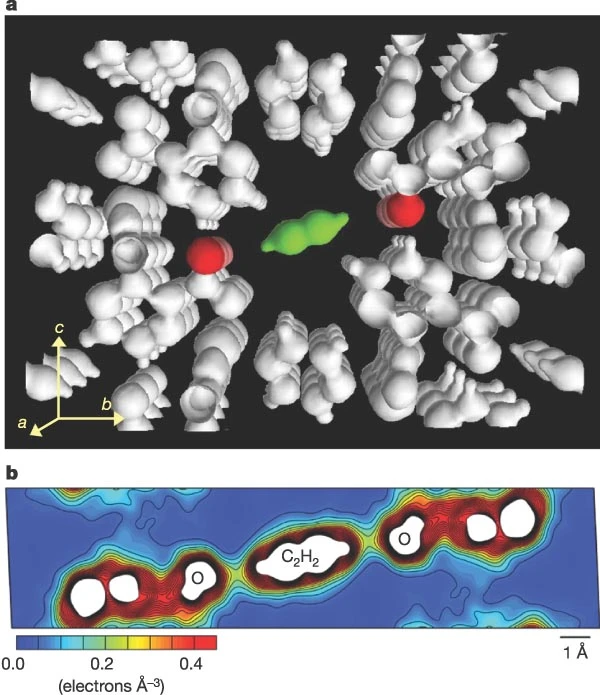
Matsuda, R., Kitaura, R., Kitagawa, S., Kubota, Y., Belosludov, R. V., Kobayashi, T. C., ... & Mita, Y. (2005). Highly controlled acetylene accommodation in a metal–organic microporous material. Nature, 436(7048), 238-241.
Metal–organic microporous materials(MOMs) have attracted wide scientific attention owing to their unusual structure and properties, as well as commercial interest due to their potential applications in storage, separation and heterogeneous catalysis. One of the advantages of MOMs compared to other microporous materials, such as activated carbons, is their ability to exhibit a variety of pore surface properties such as hydrophilicity and chirality, as a result of the controlled incorporation of organic functional groups into the pore walls.
바로가기
Article #3:
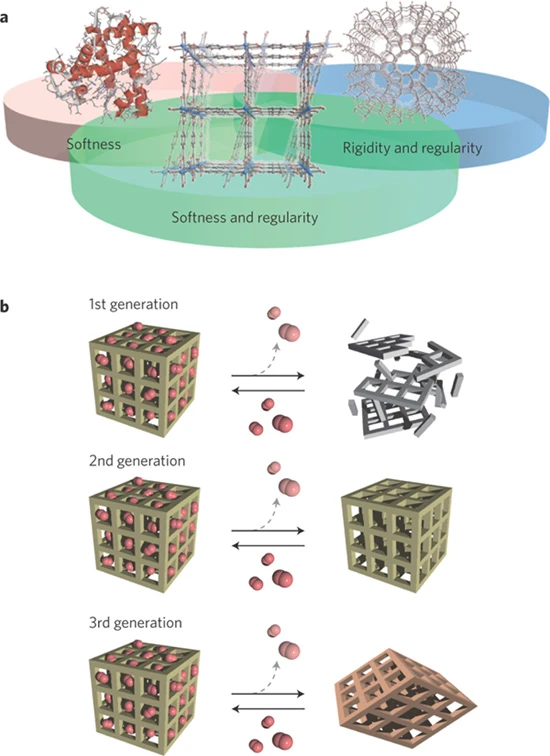
Horike, S., Shimomura, S., & Kitagawa, S. (2009). Soft porous crystals. Nature chemistry, 1(9), 695-704.
The field of host–guest complexation is intensely attractive from diverse perspectives, including materials science, chemistry and biology. The uptake and encapsulation of guest species by host frameworks are being investigated for a wide variety of purposes, including separation and storage using zeolites, and recognition and sensing by enzymes in solution. Here we focus on the concept of the cooperative integration of 'softness' and 'regularity'. 
바로가기
Laureates #2: Richard Robson
Richard Robson | The University of Melbourne
Metal–organic frameworks (MOFs) are porous materials in which metal ions and long carbon-based molecules form crystals with built-in cavities. By varying the building blocks, specific substances can be captured and stored inside the cavities. Richard Robson developed the first MOFs in 1989. Since Susumu Kitagawa and Omar Yaghi developed more flexible and stable MOFs, they have become possible to use, for example, to harvest water from desert air, capture carbon dioxide, store toxic gases or catalyse chemical reactions.

Richard Robson – Facts – 2025. NobelPrize.org. Nobel Prize Outreach 2025. Mon. 8 Dec 2025. 
바로가기
First reactions | Richard Robson, Nobel Prize in Chemistry 2025 | Telephone interview
“Some people thought it was a whole load of rubbish. But it didn’t turn out that way.” Richard Robson’s new concept for molecular architecture, which occurred to him while building models for teaching, was the starting point for the burgeoning field of metal–organic frameworks. In this conversation with the Nobel Prize’s Adam Smith, recorded just after his Nobel Prize in Chemistry was announced, he recounts how this new idea emerged and how, in the end, he just had to do something about it. He also offers some modest reflections on a long life in chemistry, which he says wasn’t exactly a vocation: “I sort of drifted into it, I couldn’t think of anything better to do.” © Nobel Prize Outreach. First reactions terms of use: https://www.nobelprize.org/ceremonies/streams-terms-of-use
바로가기
Article #1:
Robson, R. (2024). The historical development of the concepts underlying the design and construction of targeted coordination polymers/MOFs: a personal account. The Chemical Record, 24(5), e202400038.
Presented here is a personal account of how the ideas and concepts underlying the design and construction of coordination polymers/MOFs developed historically - from the earliest conjectures in the 1970’s about the possibility of using pre-organized building blocks to construct targeted polymeric structures, to the initial experimental implementation of these ideas in the mid-80’s and to the introduction of the name MOFs in the 90’s. The early exploratory work with pre-organized building blocks described in this article paved the way for the subsequent explosion of research activity in the CP/MOF area and for the generation of an essentially unlimited range of designed coordination polymer structures promising a variety of useful properties.
바로가기
Article #2:
Hoskins, B. F., & Robson, R. (1989). Infinite polymeric frameworks consisting of three dimensionally linked rod-like segments. Journal of the American Chemical Society, 111(15), 5962-5964.
We propose that a new and potentially extensive class of solid polymeric materials with unprecedented and possibly useful properties may be afforded by linking together centers with either a tetrahedral or an octahedral array of valencies by rod-like connecting units. For example, if ways could be devised of linking together tetrahedral centers and appropriate molecular rods, an infinite molecule would be generated which might be expected to adopt a structure based on either the cubic diamond lattice or the hexagonal Lonsdaleite lattice in which each C-C bond of the prototype had been replaced by a molecular rod. These frameworks would generate a regular array of cavities, interconnected by windows. When models of 3D networks based on tetrahedral centers are constructed, a very striking feature is the relatively large size of the cavities and windows produced even by rods of only modest length.
바로가기
Article #3:
Hoskins, B. F., & Robson, R. (1990). Design and construction of a new class of scaffolding-like materials comprising infinite polymeric frameworks of 3D-linked molecular rods. A reappraisal of the zinc cyanide and cadmium cyanide structures and the synthesis and structure of the diamond-related frameworks [N (CH3) 4][CuIZnII (CN) 4] and CuI [4, 4', 4'', 4'''-tetracyanotetraphenylmethane] BF4. xC6H5NO2. Journal of the American Chemical Society, 112(4), 1546-1554.
It is proposed that a new and potentially extensive class of scaffolding-like materials may be afforded by linking together centers with either a tetrahedral or an octahedral array of valences by rodlike connecting units. Some simple general principles concerning the design and construction of these frameworks are presented together with reasons for expecting them to show unusual and useful properties.
바로가기
Laureates #3: Omar M. Yaghi
Omar M. Yaghi | UC Berkeley
Omar Yaghi is widely known for pioneering metal-organic frameworks (MOFs) and covalent organic frameworks (COFs). These materials have the highest surface areas known to date, making them useful for hydrogen and methane storage, carbon capture and conversion, water harvesting from desert air, and catalysis, to mention a few. The chemistry approach he developed has led to an exponential growth in the creation of new materials. He termed this field 'Reticular Chemistry' and defines it as 'stitching molecular building blocks into extended structures by strong bonds'.
바로가기
First reactions | Omar Yaghi, Nobel Prize in Chemistry 2025 | Telephone interview
“I set out to build beautiful things and solve intellectual problems.” Omar Yaghi was just changing flights when he had heard the news that he had been awarded the 2025 Nobel Prize in Chemistry. For this conversation with the Nobel Prize’s Adam Smith, recorded as he was departing on the next leg of his journey, Yaghi speaks about his early life as a refugee in Jordan, the wonderful way his field has developed, and the overwhelming draw of the beauty of chemistry; “The deeper you dig, the more beautifully you find things are constructed.” © Nobel Prize Outreach. First reactions terms of use: https://www.nobelprize.org/ceremonies/streams-terms-of-use
바로가기
Article #1:
Furukawa, H., Cordova, K. E., O’Keeffe, M., & Yaghi, O. M. (2013). The chemistry and applications of metal-organic frameworks. Science, 341(6149), 1230444.
Crystalline metal-organic frameworks (MOFs) are formed by reticular synthesis, which creates strong bonds between inorganic and organic units. Careful selection of MOF constituents can yield crystals of ultrahigh porosity and high thermal and chemical stability. These characteristics allow the interior of MOFs to be chemically altered for use in gas separation, gas storage, and catalysis, among other applications. The precision commonly exercised in their chemical modification and the ability to expand their metrics without changing the underlying topology have not been achieved with other solids. MOFs whose chemical composition and shape of building units can be multiply varied within a particular structure already exist and may lead to materials that offer a synergistic combination of properties.
바로가기
Article #2:
Li, H., Eddaoudi, M., O'Keeffe, M., & Yaghi, O. M. (1999). Design and synthesis of an exceptionally stable and highly porous metal-organic framework. nature, 402(6759), 276-279.
Open metal-organic frameworks are widely regarded as promising materials for applications(1-15) in catalysis, separation, gas storage and molecular recognition. Compared to conventionally used microporous inorganic materials such as zeolites, these organic structures have the potential for more flexible rational design, through control of the architecture and functionalization of the pores. So far, the inability of these open frameworks to support permanent porosity and to avoid collapsing in the absence of guest molecules, such as solvents, has hindered further progress in the field(14,15). Here we report the synthesis of a metal-organic framework which remains crystalline, as evidenced by Xray single-crystal analyses, and stable when fully desolvated and when heated up to 300 degrees C. ...
바로가기
Article #3:
Eddaoudi, M., Kim, J., Rosi, N., Vodak, D., Wachter, J., O'Keeffe, M., & Yaghi, O. M. (2002). Systematic design of pore size and functionality in isoreticular MOFs and their application in methane storage. Science, 295(5554), 469-472.
A strategy based on reticulating metal ions and organic carboxylate links into extended networks has been advanced to a point that allowed the design of porous structures in which pore size and functionality could be varied systematically. Metal-organic framework (MOF-5), a prototype of a new class of porous materials and one that is constructed from octahedral Zn-O-C clusters and benzene links, was used to demonstrate that its three-dimensional porous system can be functionalized with the organic groups –Br, –NH2, –OC3H7, –OC5H11, –C2H4, and –C4H4 and that its pore size can be expanded with the long molecular struts biphenyl, tetrahydropyrene, pyrene, and terphenyl. ...
바로가기
Curated Reads / 일일 큐레이터 추천 도서
하루만에 이해하는 노벨 과학상 2025 (노벨 생리의학상, 물리학상, 화학상을 통해 보는 과학의 현재와 미래)
소장위치: 6층 과학·기술자료실 / Q173 전57 2025

하루만에 읽는 노벨 과학, 평생 남는 통찰
생리의학·물리·화학 노벨상 핵심을 한눈에 쉽게 설명하는 책
《하루만에 이해하는 노벨 과학상 2025》는 올해의 과학을 가장 쉽고 빠르게 이해하고 싶은 독자를 위한 필독서다. 현대 과학의 최전선을 상징하는 노벨 과학상은 인류가 도달한 과학의 진보를 만나는 가장 좋은 지표이다. 이 책은 과학 전문 저술가가 비전공자도 쉽게 이해할 수 있는 눈높이로 2025년 노벨 과학상을 수상한 연구자와 업적을 소개한다. 복잡한 과학 용어와 논문식 설명으로 노벨 과학상이 “무슨 이야기인지 모르겠다” 하는 독자라면 단 하루, 한 권만으로 뉴스보다 깊고, 논문보다 쉽게 현대 과학의 흐름과 통찰을 읽을 수 있다. 책은 3장으로 구성되어 각 장에서 노벨 생리의학상, 물리학상, 화학상 수상자를 소개하고, 그들의 연구와 핵심 개념을 이해하기 쉽게 설명한다. 또한, 이 연구가 인류에 어떤 공헌을 하는지 안내하여 과학의 현재뿐만 아니라 미래까지 읽을 수 있다. 하루만에 읽어도 오래 남는 과학 지식과 통찰, 노벨 과학상이라는 무대 위에서 펼쳐지는 인류의 지적 여정을 이 한 권으로 따라가 보자.
포르체 (전승민, 2025-10-29) ISBN: 9791194634638
도서관 홈페이지 바로가기
Introduction to reticular chemistry : metal-organic frameworks and covalent organic frameworks
소장위치: 6층 과학·기술자료실 / QD411 Y34 2019

서명 / 저자
: Introduction to reticular chemistry : metal-organic frameworks and covalent organic frameworks / Omar M. Yaghi, Markus J. Kalmutzki, Christian S. Diercks.

저자명 : Yaghi, Omar M. Kalmutzki, Markus J. ; Diercks, Christian S.

발행사항 : Weinheim, Germany : Wiley-VCH Verlag GmbH & Co., c2019.
도서관 홈페이지
eBook 바로가기
The chemistry of metal-organic frameworks : synthesis, characterization, and applications . v. 1-2
소장위치: 6층 과학·기술자료실 / QD411 K37 2016

서명 / 저자 : The chemistry of metal-organic frameworks : synthesis, characterization, and applications . v. 1 / edited by Stefan Kaskel.

저자명 : Kaskel, Stefan.

발행사항 : Weinheim : Wiley-VCH, c2016.
도서관 홈페이지
eBook 바로가기
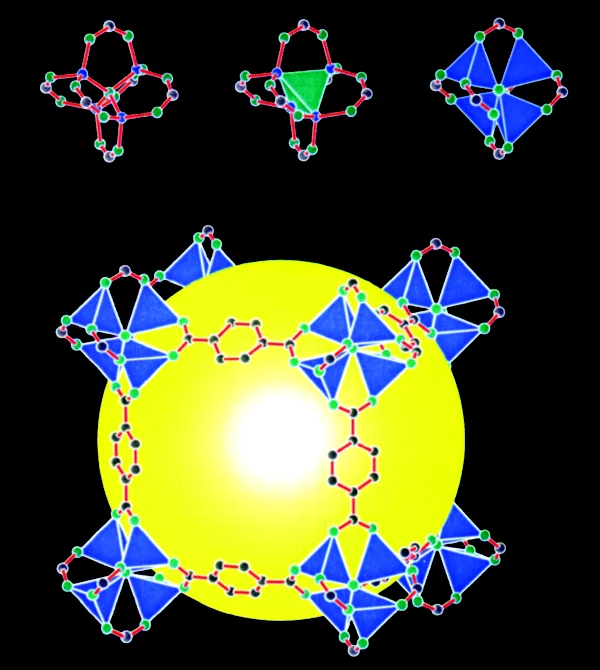
Metal-organic frameworks
서명 / 저자 : Metal-organic frameworks / Lars Öhrström & Francoise M. Amombo Noa.

저자명 : Öhrström, Lars, author. Chalmers University of Technology. Amombo Noa, Francoise M., author. Chalmers University of Technology.

단체명 : American Chemical Society.

발행사항 : Washington, DC : American Chemical Society, 2021.
도서관 홈페이지
eBook 바로가기
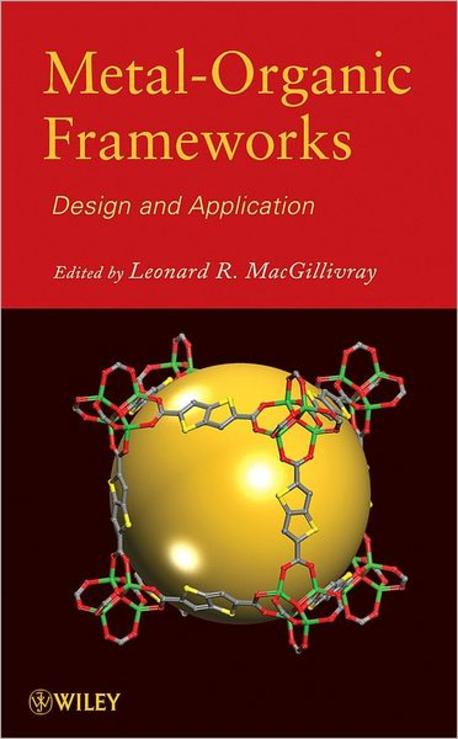
Metal-Organic Frameworks : Design and Application (Design and Application)
소장위치: 6층 과학·기술자료실 / QD882 M48 2010

Metal-organic frameworks represent a new class of materials that may solve the hydrogen storage problem associated with hydrogen-fueled vehicles. In this first definitive guide to metal-organic framework chemistry, author L. MacGillivray addresses state-of-art developments in this promising technology for alternative fuels.
Wiley (MacGillivray, L., 2010-07-08) ISBN: 9780470195567
도서관 홈페이지
eBook 바로가기
우아한 분자: 노벨 화학상 수상자의 행복한 연구 인생 (노벨 화학상 수상자의 행복한 연구 인생)
소장위치: 6층 과학·기술자료실 / QD43 S28 2023

2016년 노벨 화학상 수상자의 세렌디피티!
“화학이란 우주의 법칙과 삶의 규칙 사이에 다리를 놓는 과학이다!”-장마리 렌
화학은 무기력한 자연과 살아 숨 쉬는 자연 사이의 가교다. 분자를 서로 연결하고 사람들을 하나로 묶는 연결 고리의 과학이다. 한 줌의 불활성 원자에 생명을 불어넣을 수 있는 신비로운 기술이다.
이 책은 2016년 노벨 화학상을 수상한 프랑스의 장피에르 소바주의 연구 인생을 담고 있다. 머리말 격인 “생기 넘치는 운명”은 2016년 노벨상을 받은 이후 쏟아지는 인터뷰 요청에 대한 이야기로 시작한다. 그 많은 인터뷰를 거절하지 않은 이유를 그는 다음과 같이 설명한다.
“무엇보다 예의상 그랬고, 그다음으로 화학을 기껏해야 고등학교 시절의 나쁜 기억으로, 최악의 경우 죽도록 싫은 과학으로 여기는 일반 대중에게 미디어를 통해 친근하게 다가가기를 바랐기 때문이다. 나는 우리 시대 대부분의 사람이 ‘화학’이라는 단어에 대해 가지고 있는 고정관념, 불신, 더 나아가 철저한 무관심을 모르지 않는다. 당시 나에게 건네진 마이크가 과학자에 대한 상투적인 이미지, 예를 들면 새로 조제한 약제가 담긴 시험관을 확대경으로 살펴보는 수염 덥수룩한 연금술사나 담배를 입에 물고 이전보다 독성이 더 강한 살충제 공식을 찾아내려는 교활한 기업가와 같은 이미지를 누그러뜨리는 데 일조했다면, 나는 이것이 내게 부여된 명예에 걸맞은 의무라고 생각했다.”
아마 우리에게도 ‘화학’이란 저런 과학일 것이다. 그러나 그것이 우리의 잘못만은 아니라고 지적한다. 즉 “그러나 이러한 왜곡된 이미지는 항상 대중에게서 나오는 것이 아니라 때로 언론인에게서 나온다.” 그러면서 기초 과학 중 가장 사랑받지 못하는 이유를 화학이 가장 오해를 많이 받기 때문이라고 말한다.
이 책에는 소바주 교수팀이 이른 성취와 그가 45년 동안 연구자로서 자연에서 배운 모든 것이 담겨 있다. 또한 화학자로 최고의 영예인 노벨상을 수상하기까지 열정 가득하고 흥미로운 탐구 일대기가 파노라마처럼 펼쳐진다. 누구나 쉽게 읽을 수 있는 이 책은 그야말로 삶에 대한 찬사이자 호기심에 대한 옹호이다.
에코리브르 (장피에르 소바주, 2023-07-14) ISBN: 9788962632545
도서관 홈페이지 바로가기