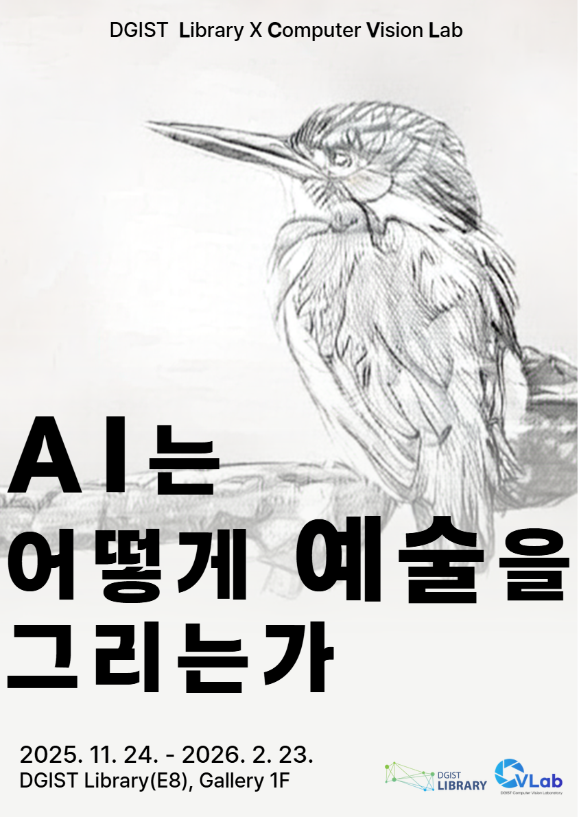
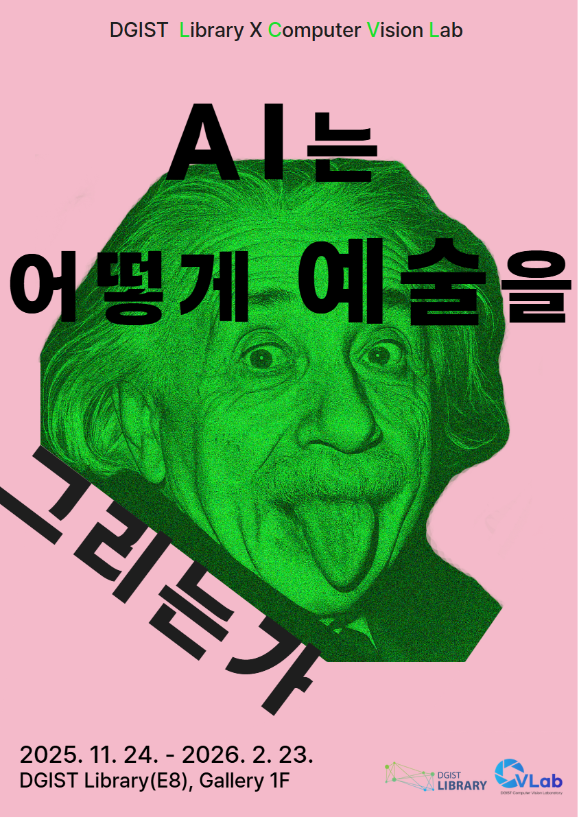
[Special Exhibition] AI는 어떻게 예술을 그리는가 : 2025. 11. 24. - 2026. 2. 23.

curated by 박민선
'AI는 어떻게 예술을 그리는가' 展은 DGIST 임성훈 교수님 연구실(DGIST 컴퓨터비전 연구실)과 협업을 통해 이미지 생성 및 스타일 변환 연구를 예술적 감각으로 확장하여 표현합니다. 연구 과정에서 축적된 데이터, 알고리즘의 학습 패턴, 그리고 모델의 출력물들을 단순한 기술적 산출물에 머무르게 하지 않고 이를 활용하여 인간과 AI가 함께 구성하는 협업적 창작과정을 감상하세요! 🔍🎨👨‍🔬👩‍🔬 “How Does AI Paint?” transforms research from DGIST’s Computer Vision Lab—spanning image generation and learning patterns—into an artistic showcase. The exhibition highlights a creative process shaped by human sensibility and AI’s computational imagination.
<AI는 어떻게 예술을 그리는가> 
이 전시는 DGIST에서 수행된 이미지 생성 및 스타일 변환 연구를 예술적 감각으로 확장한 실험적 프로젝트이다. 연구 과정에서 축적된 데이터, 알고리즘의 학습 패턴, 그리고 모델의 출력들은 단순한 기술적 산출물에 머물지 않고, AI가 세계를 인지하고 재해석하는 방식을 시각화하는 새로운 예술적 재료로 기능한다. 
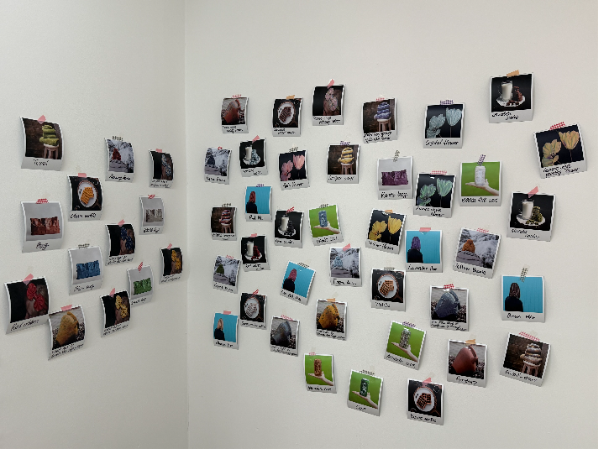
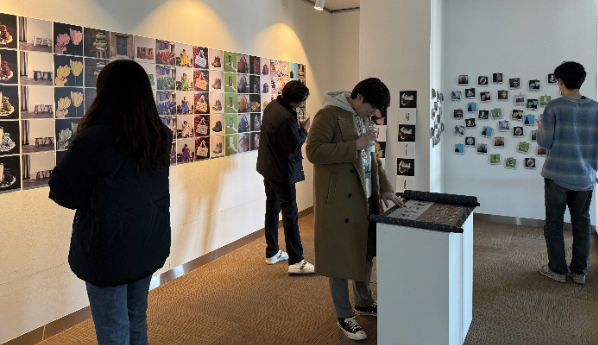
DGIST의 인공지능 연구 환경 속에서, 이미지가 '어떻게 다시 그려지는가'에 대한 기술적 질문을 예술적 질문으로 전환한다. 알고리즘은 원본 이미지의 구조를 분석하고, 다른 이미지의 질감·색채·회화적 결을 추출해 재조합하며, 인간이 예측할 수 없는 조형적 변주를 만들어낸다. 이러한 생성 과정은 단순한 자동화가 아니라, 인간과 AI가 함께 사유를 구성하는 협업적 창작 과정으로 확장된다. 전시는 다양한 매체를 통해 이 연구적 실험의 층위를 시각적으로 펼쳐 보인다. 대형 캔버스와 액자 작품은 AI가 생성한 화면을 물리적 공간 위로 옮겨 놓으며, 부직포 롤과 세트형 배열 작품들은 알고리즘이 만들어내는 반복·변형·연속성의 리듬을 드러낸다. 또한 책자형 설치물은 DGIST에서 수행된 실험 과정의 기록과 AI가 생성한 서사적 이미지들을 연결하며, 데이터·텍스트·이미지가 뒤섞인 생성적 사고의 흐름을 보여준다. 
지금 우리는 인간·비인간·비물질적 존재들의 경계가 불분명해지는 시대를 살고 있다. AI는 더 이상 인간을 보조하는 기계적 도구를 넘어, 감각적·사유적 파트너로 등장하며 새로운 예술적 상상력을 열어젖힌다. DGIST에서 수행된 연구는 이러한 새로운 관계의 가능성을 탐구하는 실험실이 되었고, 본 전시는 그 과정에서 형성된 감각적 결과물들을 공유하는 장이다. 
 《AI는 어떻게 예술을 그리는가》는 기술과 예술이 서로 다른 언어를 공유하기 시작할 때 도달할 수 있는 지점을 보여준다. 관객은 이 공간에서, AI가 단순히 이미지를 ‘만드는’ 존재가 아니라, 인간과 함께 세계를 다시 그리는 공동 창작자로 기능할 수 있음을 경험하게 될 것이다. 


<How Does AI Paint?> is an experimental project that expands DGIST’s research on image generation and style transfer into an artistic realm. The datasets, learning patterns, and model outputs accumulated throughout the research process are not treated as mere technical artifacts; instead, they become new artistic materials that visualize how AI perceives and reinterprets the world. 
Within DGIST’s AI research environment, the technical question of “how images are redrawn” becomes an artistic inquiry. Algorithms analyze the structure of an original image, extract textures, colors, and painterly qualities from others, and recombine them to create unpredictable visual variations. This generative process is not simple automation—it evolves into a collaborative creative act in which humans and AI jointly construct new modes of thought. 
The exhibition unfolds these layers of experimentation across diverse media. Large canvases and framed prints bring AI-generated images into physical space, while nonwoven rolls and set-like installations reveal the rhythms of repetition, transformation, and continuity embedded in algorithmic processes. Book-form displays connect experimental records with AI-generated narrative images, illustrating a generative flow in which data, text, and imagery intertwine. 
We live in a time when boundaries between human, non-human, and immaterial agents are increasingly blurred. AI is no longer merely a functional tool but an emerging sensory and cognitive partner that opens new artistic possibilities. DGIST’s research operates as a laboratory exploring this evolving relationship, and this exhibition shares the sensory outcomes shaped within that process. 
<How Does AI Paint?> ultimately reveals what becomes possible when technology and art begin to share a common language. Within this space, visitors encounter AI not just as a maker of images, but as a co-creator capable of redrawing the world alongside us.
<AI는 어떻게 예술을 그리는가> 연구 설명
<How Does AI Paint?> Study Description
1. Style-Editor: Text-driven Object-Centric Style Editing 
텍스트를 이용해 이미지 속 특정 객체만 스타일을 변경하는 모델. 추가적인 마스크 없이 CLIP 기반 패치 선택을 통해 객체 위치를 찾고, 해당 영역에만 스타일을 적용하며 배경은 유지한다. 
• 객체 영역 선택: TMPS + PRS 
• 객체 스타일링 손실: Patch-wise Co-Directional Loss 
• 배경 유지: Adaptive Background Preservation Loss 
→ 텍스트로 지정한 객체만 자연스럽게 스타일 바꾸는 이미지 편집 기법 

2. Content-Adaptive Style Transfer: A Training-Free Approach with VQ Autoencoders 
학습 없이 스타일 전이를 수행하는 VQ 기반 방법. 콘텐츠 구조는 유지하면서 영역별로 스타일을 다르게 적용하고, 부족한 스타일만 보정하며 원형 정보를 보존한다. 
• 콘텐츠 영역 기반 스타일 주입 (CSI) 
• 부족한 스타일 채우는 Adaptive Refinement 
• 디테일 보존을 위한 Content Refinement 
→ 학습 없이 이미지 영역에 맞추어 스타일을 입히는 VQ 기반 적응형 스타일 전이 기법 

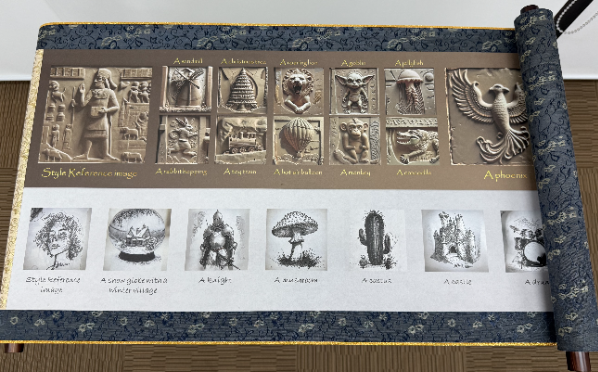
3. A Training-Free Style-aligned Image Generation with Scale-wise Autoregressive Model 
텍스트 기반 이미지 생성 시 여러 이미지 간 스타일을 일관되게 맞추는 방법. 생성 과정의 단계별 특징을 조작하여 스타일을 통합하며 학습이 필요 없다. 
• 초기 단계: Initial Feature Replacement → RGB/톤 통일 
• 중간 단계: Pivotal Feature Interpolation → 구조·배치 통일 
• 중/후반: Dynamic Style Injection → 스타일 점진적 통일 
→ 학습 없이 빠르게 생성 이미지 전반에 스타일을 맞추는 autoregressive 기반 기법 


1. Style-Editor: Text-driven Object-Centric Style Editing 
A model that modifies the style of only specific objects in an image using text prompts. Without additional masks, it locates target objects through CLIP-based patch selection and applies style edits solely to that region while preserving the background. 
• Object Region Selection: TMPS + PRS
• Object Styling Loss: Patch-wise Co-Directional Loss 
• Background Preservation: Adaptive Background Preservation Loss 
→ A text-driven image editing technique that naturally restyles only the specified object. 

2. Content-Adaptive Style Transfer: A Training-Free Approach with VQ Autoencoders
A VQ-based, training-free method for style transfer. It preserves the content structure while applying different styles to different regions, filling in missing style details and maintaining original information. 
• Content-aware Style Injection (CSI) 
• Adaptive Refinement for missing style completion 
• Content Refinement for detail preservation 
→ A VQ-based adaptive style transfer technique that applies style according to image regions without training. 

3. A Training-Free Style-aligned Image Generation with Scale-wise Autoregressive Model
A method that ensures style consistency across multiple images in text-driven image generation. It aligns style by manipulating features at different stages of the generative process—without any training. 
• Initial Stage: Initial Feature Replacement → RGB/tone alignment 
• Middle Stage: Pivotal Feature Interpolation → structural & layout consistency 
• Mid/Late Stages: Dynamic Style Injection → progressive style unification 
→ An autoregressive, training-free approach that quickly unifies the style across generated images. 
갤러리에 방문하셔서 연구결과가 어떻게 예술적으로 표현되었는지 감상하세요! 🩷💚 
Visit the gallery and experience how these research outcomes come to life as art! 🩷💚

1. 콘텐츠 적응형 스타일 전환 기술(Content Adaptive Style Transfer)
본 연구는 벡터 양자화 모델을 활용하여 클러스터링 기반 스타일 적용 기법과, 소스 이미지와 스타일 이미지의 특징 차이에 기반하여 적응형으로 소스 이미지의 스타일을 개선하는 기법, 소스 이미지와 스타일 전환 이미지의 특징 정보를 활용하여 소스 이미지의 콘텐츠 정보를 효율적으로 보존하는 기법을 통해 추가 적인 학습과정 없이 빠른 시간에 임의의 스타일 이미지에 맞게 소스 이미지의 스타일을 변경할 수 있는 기술을 제안한다.


1. Content Adaptive Style Transfer
This research proposes a technique that enables rapid style transformation of a source image to match any chosen style image without additional training. Using a vector-quantization model, the method integrates three core components: A clustering-based style application mechanism, which assigns style features by analyzing vector-quantized representations; An adaptive style refinement module, which enhances the source image’s style based on the feature differences between the source and style images; A content-preserving mechanism, which utilizes features from both the original and stylized images to effectively maintain the source image’s structural and semantic content. Through these combined processes, the technique performs fast, training-free style transfer tailored to the characteristics of the style image.
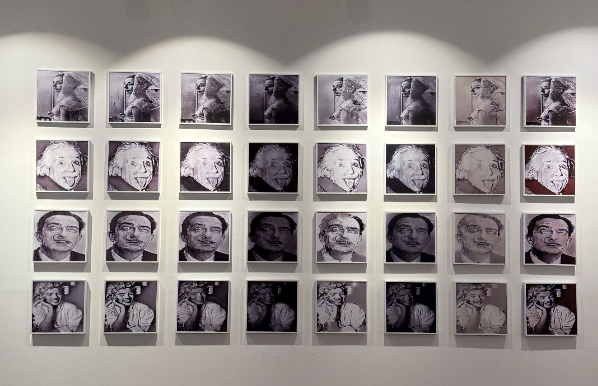
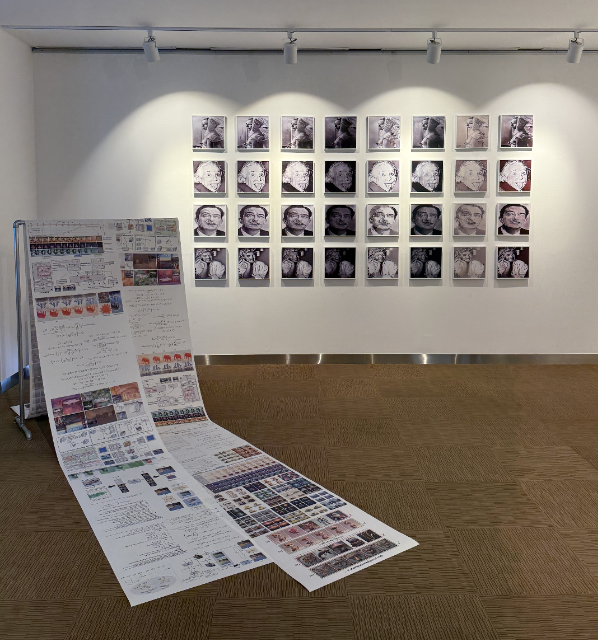
여러 인물의 이미지를 ‘콘텐츠 적응형 스타일 전환 기술’을 활용하여 다양한 흑백 이미지로 재구성했다. 
각 열에서 동일한 스타일 참조 이미지를 사용했지만, 사진마다 다른 특징 정보를 반영해 원본의 디테일을 유지한 채 개별 이미지에 최적화된 스타일이 적용된다.
Using the Content-Adaptive Style Transfer technique, images of multiple individuals were reinterpreted into various black-and-white styles. Although each row is generated using the same style reference image, the method adapts the style to the unique feature information of each photograph, preserving the original details while applying an optimized style to every individual image.
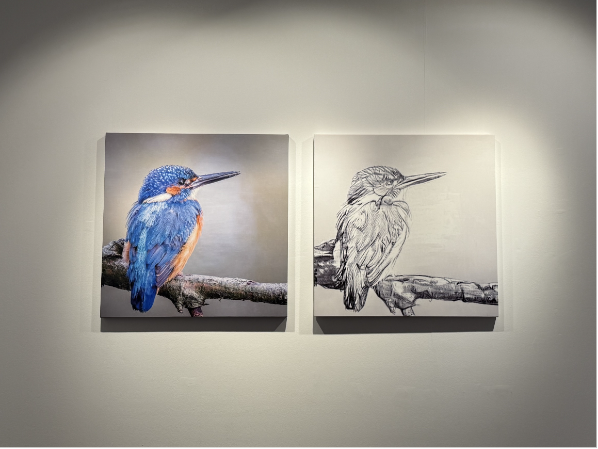
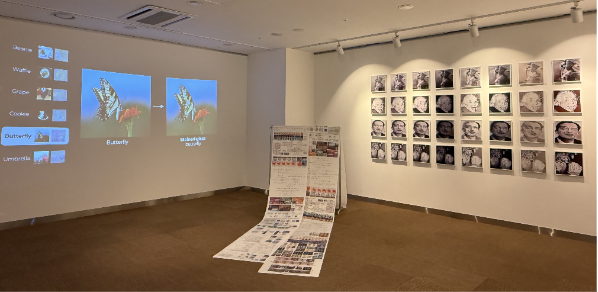
오른쪽의 스케치 이미지는 ‘콘텐츠 적응형 스타일 전환 기술’을 적용해 왼쪽 파랑새 이미지를 변환한 것이다. 파랑새 이미지의 특징 정보를 기반으로 새, 나뭇가지와 배경 영역이 분리되어 스타일이 자연스럽게 입혀진다.
The sketch image on the right is a transformation of the bluebird image on the left using the Content-Adaptive Style Transfer technique. Based on the feature information of the original bluebird image, the method separates the bird, branch, and background regions, allowing the style to be applied naturally to each part.
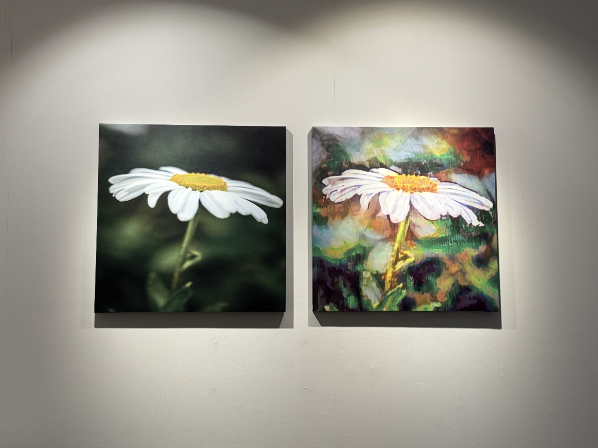
오른쪽의 페인팅 이미지는 같은 기술을 활용하여 왼쪽 꽃 이미지를 변환하여 얻은 결과이다. 꽃뿐만 아니라 배경 속 영역별 특징 차이에 따라 서로 다른 색감이 적용되며, 전체적으로 색이 다채로운 회화 분위기가 형성된다.
The painting on the right was generated by applying the same technique to the flower image on the left. Not only the flower but also the background is stylized differently according to the feature variations within each region, creating a richly colored, painterly atmosphere overall.

2. 텍스트 기반의 객체 중심 스타일 전환 기술(Text-driven object-centric style editing)
본 연구는 사용자로부터 입력받은 소스 텍스트에서 추출한 중심단어와 스타일 텍스트를 결합한 새로운 타겟 텍스트를 구성하여 소스 텍스트와 타겟 텍스트가 이루는 각도와 소스 이미지의 선택된 패치들과 스타일이 전환된 해당 패치들이 이루는 각도가 같아지도록 하는 손실 함수와, CLIP 특징 공간 상에서 두 패치들 사이의 분포와 동일하게 유지되도록 하는 손실함수를 통해 객체의 디테일을 보 존하면서 정확한 스타일 전환이 가능한 기술을 제안한다. 스타일을 전환하도록 선택된 객체 중심의 패치를 제외한 부분에 대해서는 원본 이미지와 같아지도록 하는 손실함수를 통해 전체 이미지 중 객체에 해당하는 영역만 스타일 전환이 가능하도록 하였다.


2. Text-driven Object-Centric Style Editing
This research proposes a technique that enables precise style editing of specific objects in an image based on user-provided text. A new target text is constructed by combining the key terms extracted from the source text with the style text. A loss function is then applied to align the angle between the source and target texts with the angle between the selected patches of the source image and the corresponding stylized patches. Another loss function ensures that the distribution between the two patches remains consistent within the CLIP feature space, allowing accurate style transfer while preserving object details. For regions outside the object-selected patches, an additional loss function enforces similarity to the original image, ensuring that only the object region undergoes style transformation, while the rest of the image remains unchanged.
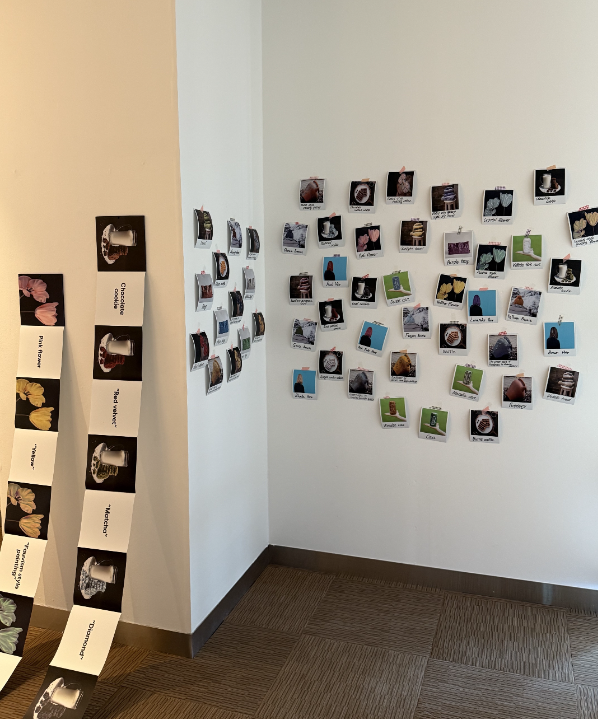
각 이미지는 ‘텍스트 기반의 객체 중심 스타일 전환 기술’을 활용해, 각 열의 맨 위에 있는 원본 이미지 속 객체를 다양한 스타일로 변환한 결과이다. 텍스트만으로 변환할 객체를 지정하고 스타일을 적용했으며, 이미지 안에 여러 객체가 존재하는 경우에도 지정한 객체만 자연스럽고 다양하게 스타일이 변화한다.
Each image was generated using the Text-driven Object-Centric Style Editing technique, transforming the object in the original image at the top of each column into various styles. With text prompts alone, the method identifies the target object and applies the desired style, enabling natural and diverse style changes even when multiple objects are present in the image, while altering only the specified one.
이 영상은 ‘텍스트 기반의 객체 중심 스타일 전환 기술’이 원본 이미지로부터 결과 이미지를 만들어내는 과정을 시각화한 것이다. 스타일 전환이 진행될수록, 텍스트로 지정된 객체 영역만 스타일 텍스트에 따라 변화하며, 그 외의 영역은 원본과 유사하게 되는 것을 확인할 수 있다.
This video visualizes the process by which the Text-driven Object-Centric Style Editing technique generates a stylized result from the original image. As the style transfer progresses, only the object specified by the text prompt changes according to the style description, while the rest of the image remains close to the original.

3. 스타일 개인화 이미지 생성 기술(Style-personalized image generation)
본 연구는 사전 학습된 다음 scale을 예측하는 자가회귀형 생성 모델의 각 생성 단계 및 어텐션 특성을 분석하여, 참조 이미지의 스타일을 유지하면서 콘텐츠 구성을 가이드하는 핵심 단계 어텐션 공유 기법과, 스타일 개인화된 이미지 생성을 하면서도 효과적으로 프롬프트 정보를 반영하도록 하는 적응형 쿼리 공유 기법을 통해 추가적인 학습 과정 없이 빠른 시간에 주어진 참조 이미지의 스타일로 개인화된 이미지 생성이 가능한 기술을 제안한다.


3. Style-Personalized Image Generation
This research proposes a technique for generating personalized images in the style of a given reference image without any additional training. By analyzing the generation steps and attention patterns of a pretrained scale-wise autoregressive model, the method introduces two key mechanisms: Key-Stage Attention Sharing, which guides content composition while preserving the style of the reference image by sharing attention maps at crucial stages; Adaptive Query Sharing, which effectively incorporates prompt information even during style-personalized image generation. Through these combined strategies, the technique enables fast and consistent image generation that reflects both the user’s prompt and the distinctive style characteristics of the reference image.
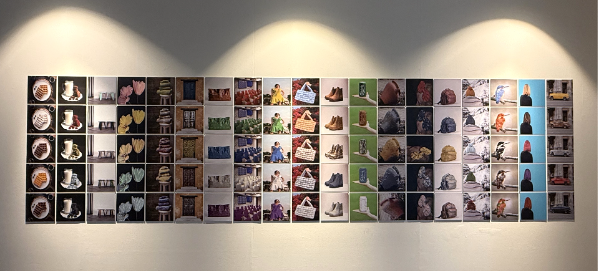
각 이미지는 ‘스타일 개인화 이미지 생성 기술’을 활용해 맨 왼쪽 스타일 참조 이미지를 기반으로 텍스트에서 생성된 결과물이다. 참조 이미지의 고유한 스타일을 충실히 반영하면서도, 입력된 텍스트의 내용에 맞춰 새로운 이미지가 자연스럽게 만들어진다.
Each image was generated using the Style-Personalized Image Generation technique, based on the style reference image shown on the far left and the accompanying text prompt. The method faithfully preserves the unique style of the reference image while producing new images that naturally reflect the content described in the text.

↑ DGIST 임성훈 교수님 연구실 (DGIST 컴퓨터비전 연구실) 👨‍🔬👩‍🔬
DGIST Prof. Sunghoon Im’s Research Lab (DGIST Computer Vision Lab)

※ 본 큐레이션의 디지털 이미지 무단 복제는 절대 불가합니다. 
 ※ Unauthorized reproduction of digital images from this curation is strictly prohibited.